Fixed-shape Transformer baseline
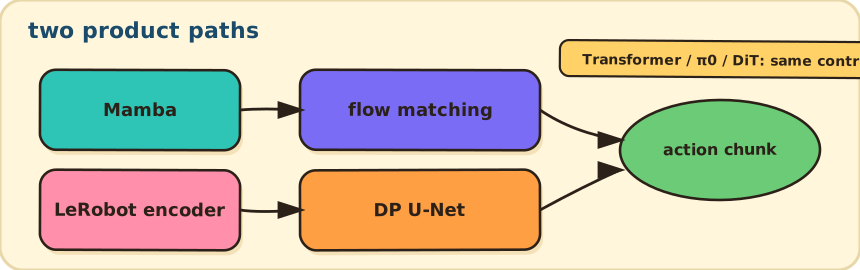
The product heads are flow matching and Diffusion Policy. This page is the
GPT-2 decoder fixture and the cached SmolVLA expert (VLM stays in LeRobot). Everyday
benches: python -m flowedge_dev. Numbers vs PyTorch for the two product heads:
Performance.
FlowEdge has a general causal Transformer decoder beside Mamba. It is a fixed-shape, batch-one CPU baseline for the GPT-style contract in issue #10. It is not a generic Hugging Face loader, a production VLA, or a SmolVLA implementation.
cached_causal_attention lives in kernels.h with GELU, LayerNorm, and
softmax. gtests cover those kernels plus KV reset, max-prefix reject, prefix
versus stream, and the embedding mask. sshleifer/tiny-gpt2 is the CI
conversion fixture. openai-community/gpt2 is optional local evidence — same
model_type: gpt2 converter, not a policy result.
Contract
The checkpoint carries an explicit transformer.config F32 vector:
[vocab, d_model, n_layers, n_heads, max_sequence, mlp_dim].
Tensor names are deliberately FlowEdge-native: token and learned-position
embeddings, pre-attention and pre-MLP affine LayerNorms, fused QKV projections,
attention output projections, GELU MLP projections, and final LayerNorm. All
KV buffers are allocated at initialization as [layer][position][hidden].
run(tokens) resets and fills that cache. step(token) appends one key/value
per layer and attends only to positions through the current token. No synthetic
C++ checkpoint fixture is used as release evidence; an actual converted policy
and a matched reference replay are required before this baseline can be called
deployed.
The C and Python APIs also expose run_embeddings, which accepts caller-owned
[sequence, d_model] F32 rows and runs the same reset-and-prefill path. An
optional batch-one prefix attention_mask (1 values followed by padding 0
values) makes the condition-sequence boundary explicit for VLA adapters. This
is groundwork for SmolVLA; it does not implement cross-attention, the VLM, or
the current SmolVLA action expert.
The converter is exercised with the downloaded sshleifer/tiny-gpt2 checkpoint
at revision 5f91d94bd9cd7190a9f3216ff93cd1dd95f2c7be. It compares Hugging Face
hidden states against native full-prefix and streaming execution on prefix
[1,2,3,4]:
python -m flowedge_dev verify transformer \
  models/tiny-gpt2 models/tiny-gpt2.flowedge.safetensors \
  --binary build/transformer_forward \
  --model-id sshleifer/tiny-gpt2 \
  --output bench/artifacts/transformer/tiny-gpt2-transformer-reference.json
This validates real checkpoint conversion, full-prefix execution, and streaming KV-cache parity only; it is not an action-policy result.
Optional local GPT-2 (same converter, larger weights; not required for CI):
hf download openai-community/gpt2 --local-dir models/gpt2
python convert/convert.py models/gpt2 models/gpt2.flowedge.safetensors --arch transformer
python -m flowedge_dev verify transformer \
  models/gpt2 models/gpt2.flowedge.safetensors \
  --binary build/transformer_forward \
  --model-id openai-community/gpt2 --revision main \
  --output bench/artifacts/transformer/gpt2-transformer-reference.json
Record decoder latency on this host (not a policy p50):
build/transformer_latency models/tiny-gpt2.flowedge.safetensors \
  --threads 0 --warmup 5 --iters 20 \
  --output bench/artifacts/transformer/tiny-gpt2-latency.json \
  1 2 3 4
Verify the external-embedding boundary against the same real checkpoint (the
Python module must be built with FLOWEDGE_PYTHON=ON):
python tools/verification/verify_transformer_embeddings.py \
  models/tiny-gpt2.flowedge.safetensors --module-path build \
  --output bench/artifacts/transformer/tiny-gpt2-transformer-embeddings.json
Check that the real checkpoint’s streaming path performs no heap allocation after initialization:
build/flowedge_model_lifecycle_check models/tiny-gpt2.flowedge.safetensors \
  --stream 1 2 3 4 --cycles 3
SmolVLA preflight
SmolVLA is architecturally different from the baseline: it has a visual-language
encoder and an action expert with RMSNorm, RoPE, grouped-query self/cross
attention, and SwiGLU. tools/smolvla_preflight.py validates the exact tensor
layout of the pinned lerobot/smolvla_base checkpoint before conversion:
python tools/smolvla_preflight.py models/smolvla_base/model.safetensors \
  --config models/smolvla_base/config.json --hash \
  --output bench/artifacts/smolvla/smolvla-base-preflight.json
The resulting manifest establishes the real-source contract only. It records
supported_by_flowedge: false; the native path is intentionally partial until
the source encoder, captured-VLM expert replay parity, complete Euler action
integration, and matched task evaluation are available.
The first native action-expert boundary is now implemented for the real checkpoint: action projection, the exact SmolVLA sine/cosine timestep embedding, the time MLP, and checkpoint-derived dimensions. Verify it against PyTorch with:
python tools/verification/verify_smolvla_action_expert.py \
  models/smolvla_base/model.safetensors \
  --module-path build-research \
  --output bench/artifacts/smolvla/smolvla-action-expert-suffix.json
This artifact is projection parity only. It does not execute the VLM image or language encoder, cached-VLM self/cross-attention replay, or a policy rollout.
With the upstream VLM weights available locally, capture a separate source policy-construction record:
python tools/verification/verify_smolvla_source.py models/smolvla_base \
  --output bench/artifacts/smolvla/smolvla-base-upstream-load.json
This proves only that the pinned upstream SmolVLAPolicy can construct from
the local checkpoint. It is not FlowEdge inference or an action-quality result.
SmolVLA source-parity capture contract
To validate the captured VLM cache and native action expert, export a source action chunk from a
real observation captured through the upstream LeRobot processor. The .npz
capture must contain batch-one, pre-processor tensors:
observation.state: F32[1, 6];one or more configured
observation.images.*fields: F32[1, 3, height, width]RGB values in[0, 1]. Keep each real camera at the resolution emitted by the source pipeline; SmolVLA performs its own resize-with-padding. Do not duplicate a view to fill an absent camera;observation.language.tokens: I64[1, 48];observation.language.attention_mask: boolean[1, 48], emitted by LeRobot’s tokenizer.noise: F32[1, 50, 32], captured once and reused by every implementation.
For cached-expert replay, add noisy_actions (F32 [1, 50, 32]) and
timestep (F32 [1]); they identify one actual source denoising step.
For a recorded LeRobot v3 parquet/video sample, create this capture without resizing or duplicating camera pixels. Map only the cameras actually present in the record to the checkpoint’s configured keys:
python tools/verification/capture_lerobot_frame.py models/smolvla_base data.parquet \
  --frame-index 0 --task "Recorded task" --noise-seed 17 \
  --camera observation.images.camera1=top.mp4 \
  --camera observation.images.camera2=wrist.mp4 \
  --dataset-id namespace/dataset --dataset-revision COMMIT --dataset-license SPDX \
  --output real-observation.npz --manifest real-observation.json
--frame-index identifies the parquet row. When a video shard starts at a
different dataset index, pass its local ordinal with --video-frame-index.
python tools/verification/export_smolvla_reference.py \
  models/smolvla_base real-observation.npz \
  --output smolvla-source-action.npz \
  --manifest smolvla-source-action.json
The exporter does not synthesize defaults and rejects missing, reshaped, or non-RGB-range inputs. Its action chunk and JSON digests form the later FlowEdge parity target.
Cached-VLM action-expert replay
For the native expert boundary, preserve one real denoising input in the same
capture as noisy_actions (F32 [1, 50, 32]) and timestep (F32 [1]). The
exporter builds the upstream prefix once, retains its RoPE-applied VLM K/V
cache, and records the expected expert hidden state and velocity. It does not
fill in missing values:
The source cache is [1, prefix, 5, 64] per layer and is transported to
FlowEdge as [16, prefix, 320]. Its validity mask may be sparse: LeRobot
right-pads language tokens before appending the valid state token. The replay
verifier therefore compares BF16 hidden states with a 0.1 maximum-error
default, action velocity with 0.08, and the ten-step Euler result with
0.03. These are explicit cross-runtime BF16 envelopes, not accuracy or
task-quality thresholds.
python tools/verification/export_smolvla_expert_reference.py \
  models/smolvla_base real-observation.npz \
  --output smolvla-expert-reference.npz \
  --manifest smolvla-expert-reference.json

python tools/verification/verify_smolvla_cached_expert.py \
  models/smolvla_base/model.safetensors smolvla-expert-reference.npz \
  --module-path build-research \
  --output bench/artifacts/smolvla/smolvla-cached-expert.json
The report is the required evidence for the cached-VLM action-expert path. It does not validate preprocessing, VLM encoding, the full ten-step flow solve, timing, or control quality.
Cached-VLM Euler trajectory replay
The native smolvla_sample call implements the source’s deterministic Euler
schedule (t = 1 - step / N, x += -v / N) from caller-owned noise. Add the
same real noise input used by the upstream action call to produce a complete
trajectory target from the cached VLM prefix:
python tools/verification/export_smolvla_expert_reference.py \
  models/smolvla_base real-observation.npz \
  --output smolvla-expert-reference.npz \
  --trajectory-output smolvla-trajectory-reference.npz

python tools/verification/verify_smolvla_cached_trajectory.py \
  models/smolvla_base/model.safetensors smolvla-trajectory-reference.npz \
  --module-path build-research \
  --output bench/artifacts/smolvla/smolvla-cached-trajectory.json
This establishes expert-side Euler replay from an externally generated cache. The source-pipeline boundary can also be exercised end to end through the installed LeRobot provider and compared against the source action chunk:
python tools/verification/verify_smolvla_hybrid.py \
  models/smolvla_base/model.safetensors models/smolvla_base \
  bench/artifacts/smolvla/eslab-frame-000000.capture.npz \
  --module-path build-research \
  --output bench/artifacts/smolvla/eslab-frame-000000.hybrid-action.json
The resulting report covers source LeRobot image/state/language preprocessing,
the source VLM prefix/cache provider, and the native FlowEdge action expert for
the full 50 x 6 action chunk. It remains source-owned preprocessing/VLM plus
native expert execution: this is not native VLM/full-native SmolVLA evidence,
and it makes no latency, control-quality, or task-success claim.
The native inspector recognizes this real checkpoint schema but fails closed:
build/flowedge-inspect models/smolvla_base/model.safetensors --json
The report identifies family: "smolvla" and explains that the LeRobot
preprocessing boundary and VLM encoder are not implemented natively. The
action expert can consume an external cache, while the hybrid report verifies
the source provider-to-native-expert seam; neither is a claim of native full
SmolVLA support.
For a portable evidence artifact, run the verifier against the same binary:
python tools/verification/verify_smolvla_inspection.py \
  models/smolvla_base/model.safetensors \
  --binary build/flowedge-inspect \
  --output bench/artifacts/smolvla/smolvla-base-inspection.json