Cooperative jobs
Use one Relay contract for bounded stateful work.
Kind |
One work unit |
Typical state |
|---|---|---|
Iterative |
Denoise, ODE, optimization, planning step |
Latent, solver stage, step |
Streaming |
Token, recurrence update, bounded chunk |
SSM/KV state, position |
Speculative |
Draft or verification quantum |
Accepted prefix, branch, rollback state |
Backend contract
struct Backend {
  bool prepare(std::span<const std::byte>) noexcept;
  bool begin() noexcept;
  fe::relay::BackendAdvance advance(std::size_t budget) noexcept;
  void cancel() noexcept;
  std::size_t state_bytes() const noexcept;
  bool save_state(std::span<std::byte>) const noexcept;
  bool load_state(std::span<const std::byte>) noexcept;
  std::span<const std::byte> result() const noexcept;
};
RoutedBackend checks this surface at compile time. The backend remains caller-owned and must outlive
its registry and worker pool.
Production Mamba adapter
MambaStreamAdapter maps one token to one streaming work unit. Each lane owns mutable recurrence
state while lanes share immutable weights.
auto adapter = MambaStreamAdapter::open(shared_weights, 512, 0u).value();
std::array<std::byte, 2048> input;
auto bytes = encode_mamba_stream_request(tokens, input).value();
auto descriptor = adapter.make_descriptor(session, generation, tokens.size(), deadline_ns);

std::array<JobAdapterRegistration, 1> entries;
JobAdapterRegistry registry{entries};
registry.add(adapter.registration());
registry.freeze();
The adapter preallocates token/output storage, derives identity from Core metadata, and moves the
exact recurrent snapshot in a canonical state capsule. See examples/relay/mamba_relay_stream.cc.
Drain a worker lane
Reserve capsule storage when creating the pool, then request a drain from the coordinator thread:
auto capsule_capacity = state_capsule_bytes(adapter.max_state_bytes());
auto pool = JobWorkerPool::create(
    lanes, 32, costs, 64, 1, WorkerPlacement::kCompact, &events, capsule_capacity).value();

pool.request_worker_drain(worker_index);
// Keep polling JobService or ready_result() while the handoff completes.
pool.resume_worker(worker_index);
State at request |
Result |
|---|---|
Idle |
Lane becomes drained immediately |
Running + compatible target |
Capsule moves at the next work boundary |
Running + no target/capacity |
Current job finishes; lane then drains |
Accepted queue would be stranded |
|
Drained lanes reject new dispatch. migration_started and migration_completed identify both
workers. One job performs at most one live handoff; draining its destination lets that job finish.
Identity and scheduling
Descriptor field |
Contract |
|---|---|
|
Iterative, streaming, or speculative cost class |
|
Exact weights/configuration identity |
|
Adapter payload version |
|
Stateful stream or robot |
|
Freshness and cancellation watermark |
|
Monotonic deadline; zero disables admission |
|
Exact bounded work required |
One work unit must end at a safe cancellation/migration point. Relay rejects zero budgets, over-reported progress, early completion, incompatible state, and work beyond the admitted bound.
Route and observe
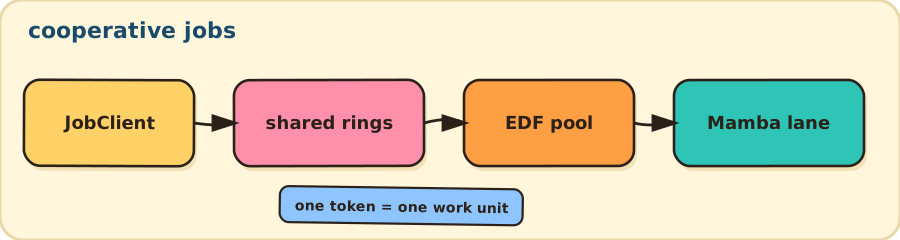
Provision one backend and frozen registry per lane:
std::array<Backend, 2> backends;
std::array<std::array<JobAdapterRegistration, 1>, 2> entries;
std::array<JobAdapterRegistry, 2> lanes{
    JobAdapterRegistry{entries[0]}, JobAdapterRegistry{entries[1]}};
for (std::size_t i = 0; i < lanes.size(); ++i) {
  lanes[i].add(make_routed_adapter(
      backends[i], job_route(descriptor), max_input_bytes, max_output_bytes));
  lanes[i].freeze();
}
auto events = JobEventBuffer::create(256).value();

auto pool = JobWorkerPool::create(
    lanes, 32,
    JobCostPolicy{.iterative_ns = step_ns,
                  .streaming_ns = token_ns,
                  .speculative_ns = quantum_ns},
    64, 1, WorkerPlacement::kCompact, &events).value();

pool.submit(request, now_ns);
while (pool.ready_result() == nullptr)
  std::this_thread::yield();
consume(*pool.ready_result());
pool.release_ready_result();
pool.release_session(descriptor.session_id);
For another process, connect the same pool to a typed service:
auto service = JobService::create("jobs-in", "jobs-out", pool, 32).value();
while (!service.stopped()) {
  if (service.poll() == JobServiceResult::kIdle)
    std::this_thread::yield();
}
The producer uses JobClient::connect, try_submit, and try_receive. Full output rings retain the
result inside the service or worker lane. Drain events into JobMetrics or TraceWriter outside
compute. See Observability.
Move a running job
auto source = make_iterative_job(source_backend, descriptor).value();
source.start();
source.advance(3);
source.export_capsule(preallocated_capsule);

auto destination = make_iterative_job(destination_backend, descriptor).value();
destination.restore_capsule(preallocated_capsule);
destination.advance(descriptor.total_work_units);
Capsules are canonical little-endian and fingerprint the full record. Restore validates version,
model, schema, session, generation, deadline, kind, work count, and checksum before backend state is
committed. Use StateWriter/StateReader for adapter payloads.
Limits
Limit |
Behavior |
|---|---|
Inline payload |
64 KiB by default; keep large tensors in runtime/device memory |
Registries |
Frozen before pool creation; lookup is |
Sessions |
Fixed capacity; call |
Mutable backend |
Never shared concurrently; immutable weights may be shared |
Generic transport |
Separate SPSC request/result rings; |
Run
./build/cooperative_job_sample
./build/routed_job_sample jobs.trace
./build/mamba_relay_stream models/mamba_flow.safetensors
./build/src/relay/flowedge-relay-trace inspect jobs.trace --jsonl
./build/flowedge_cooperative_job_bench 1000000
./build/flowedge_mamba_stream_bench models/mamba_flow.safetensors 5000
./build/flowedge_worker_drain_bench 10000
The benchmarks cover synthetic framework overhead, production Mamba routing/migration, transport, metrics, and runtime allocation checks.