Backbones
A backbone reads the token prefix and returns a conditioning vector, the last hidden state. It also runs O(1) streaming decode.
Mamba
Mamba is a selective state-space model. At its core is a linear recurrence over a hidden state \(h\), written in continuous form as:
With a step size \(\Delta\) this discretizes into the recurrence the engine runs directly:
It is selective, meaning \(\Delta_t\), \(B_t\), and \(C_t\) are functions of the input \(x_t\), and \(A = -\exp(A_{\log})\) is diagonal per state and channel. Each layer:
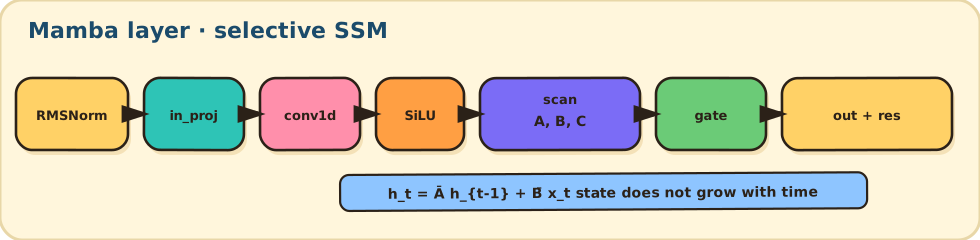
Config comes from the checkpoint shapes, and the state is \(d_{inner} \times d_{state}\). Streaming decode keeps a conv window and \(h\) per layer and advances one step per token. The batch path clears its temporary recurrence; the streaming path deliberately preserves the caller-owned state. That distinction is part of the kernel contract and is checked by batch-versus-streaming tests.
Why this way
Attention is \(O(L^2 d)\) with a growing KV cache. The SSM is \(O(L\, d_{inner} d_{state})\) with state that does not grow with \(L\). Diagonal \(A\) makes \(\bar{A} h_{t-1}\) a Hadamard product. discretize_and_scan fuses the rest; \(-\exp(A_{\log})\) is transposed once at load. Streaming decode is one step of the same recurrence.
Source: src/core/models/mamba/. ADR 0002.
Transformer
CPU decoder baseline: fused QKV, learned positions, KV cache sized to
max_sequence, cached_causal_attention in kernels.h. Kernel and fixture
gtests plus the tiny-gpt2 conversion artifact. Not a policy. See
Fixed-shape Transformer baseline.