Heads
A head takes a conditioning vector and a noise sample and returns an action chunk. It is backbone-agnostic: any backbone that produces a vector of the right size can drive any head.
Flow matching
The head is a velocity field \(v_\theta(x, t \mid c)\), and sampling integrates an ODE from noise to action:
Training regresses \(v_\theta\) onto the velocity of a straight path between noise and data, \(x_t = (1-t)\,x_0 + t\,x_1\), whose target velocity is the constant \(x_1 - x_0\). Sampling then integrates with a fixed number of function evaluations:
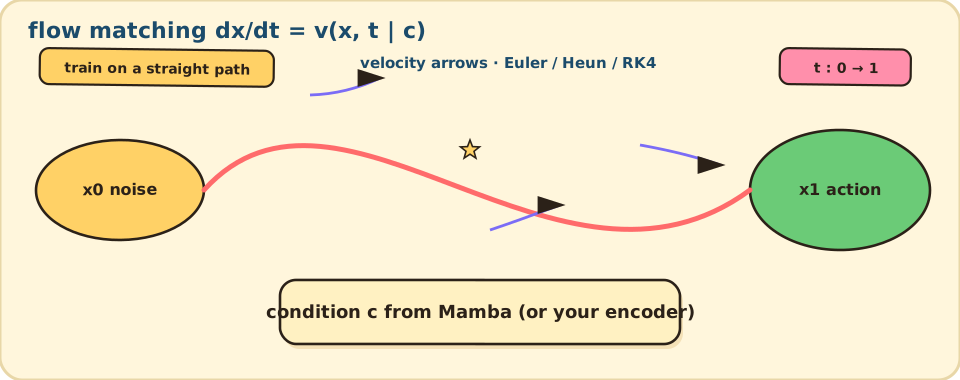
Heun uses two evaluations per step and RK4 uses four. Conditioning \(c\) is projected once and reused.
The flow head can be loaded without a backbone and driven directly by an external condition vector. That makes the solver usable behind vision-language-action models, observation encoders, and model servers that should not be linked into the core engine.
Sampling also has a resumable form. sampler_begin stores the projected condition, current action,
and Runge-Kutta stages in caller-owned fixed workspace. sampler_advance runs a bounded number of
complete ODE steps. Splitting a solve does not change floating-point operation order, so the final
action is bit-identical to a monolithic solve on the same backend. With FLOWEDGE_BACKEND=cuda,
weights and ODE scratch stay on device after load; the public spans stay host pointers.
Why this way
A robot period is a budget of velocity-net evaluations (NFE). Flow matching is a straight-path ODE: about ten evals, no RNG, condition (c) projected once. A diffusion head often spends dozens of stochastic steps on the same action. That is why flow matching is the default, and why DP is the other first-class head only when that is the trained checkpoint.
PyTorch can run both. It does not give you a slab sized at load or a miss contract. Split at solver steps (flow_begin / flow_advance), never inside a matmul. Cooperative execution.
Source: src/core/heads/flow/. ADR 0004.
Diffusion Policy
The head is an epsilon network (\epsilon_\theta(x_t, t \mid c)) on a noisy
action horizon (x_t). Training is the usual noise-prediction objective.
Sampling inverts that process. DDIM is a deterministic reverse walk (no
RNG; NFE equals the step count). DDPM keeps the stochastic term and is
seeded for reference. After the last step, checkpoint MIN_MAX statistics map
the horizon back to dataset action units. Each DDIM step is one U-Net forward
plus a closed-form scheduler update; (c) is reused. With FLOWEDGE_BACKEND=cuda,
weights and U-Net/DDIM scratch stay on device after load; the public spans stay
host pointers.
The fixed-shape ConditionalUnet1D is the LeRobot Conv1D U-Net: GroupNorm,
Mish, sinusoidal timestep embedding, FiLM scale/bias. Observation encoding
stays outside Core so the same head can sit behind LeRobot, a VLA, or
TensorRT. See the Diffusion Policy guide.
ACT and others
Planned, behind the same contract. See the head guide and the roadmap.