Loader
Reads a .safetensors file with no dependencies.
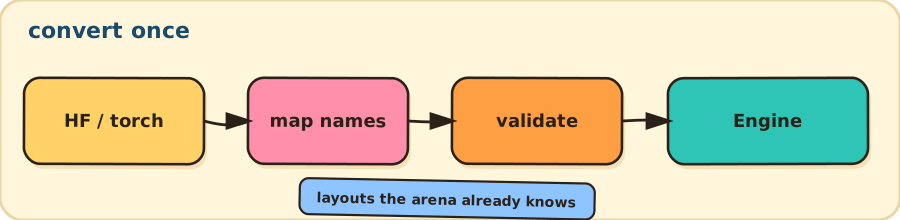
mmap the file.
Parse the JSON header with a hand-written scan.
Copy each tensor into the arena while preserving its F32 or BF16 representation.
Fill a fixed table of
TensorView, each holding a name, shape, and pointer.
The header is read once at load, and every offset is bounds-checked.
BF16 storage
BF16 is the top half of an IEEE-754 float: 1 sign bit, 8 exponent bits, 7 mantissa bits. It keeps the exponent range of F32, so widening is a left shift, exact and lossless:
The loader preserves BF16 weights to halve memory traffic. Matmul widens them directly in its SIMD register path; small vectors and activations remain F32.
Why this way
Loading is a data-movement problem, so the design targets page residency and layout, not parse speed.
mmap maps the file into the address space without a read syscall per tensor. But a mapped page is not resident until it is first touched, and a first touch during a step is a minor fault that blows the latency budget. The copy into the arena is the pre-fault: it walks every weight once at load, so the pages are warm before the control loop starts.
The copy also fixes layout. File offsets are not 64-byte aligned. Moving a tensor into the arena makes it 64-byte aligned, so kernels can load it predictably.
BF16 is widened inline only where a matmul consumes it. That keeps the long-lived weight footprint compact while preserving F32 activations. See ADR 0009.
The header is a flat map of name to dtype, shape, and byte offsets, so a hundred-line scan reads it. A JSON library would add a dependency, binary size, and a supply-chain surface for a grammar this small.
Source: src/core/loader/safetensors.h and safetensors.cc.