Reproducible policy reports
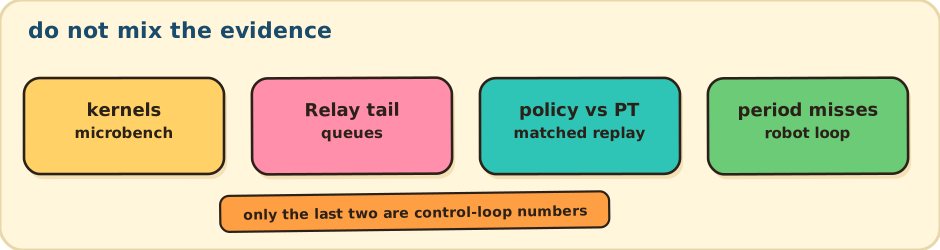
Matched Diffusion Policy p50 vs LeRobot/PyTorch is this recipe. Flow matching ULP and graph compilers live on Performance — do not mix those rows.
Run one report
python -m flowedge_dev bench policy models/policy.safetensors \
  --source models/diffusion_pusht --revision <revision> \
  --steps 10 --iterations 100 --warmup 5 --threads 1 \
  --output bench/artifacts/policy/diffusion-pusht-report.json
The published CPU replay used --threads 1. CUDA matched replay uses
--device cuda and records the CUDA device name; threads=1 is not the GPU
headline. Do not mix thread counts or devices across backends.
Output |
Includes |
|---|---|
JSON |
model/processor hashes, contract, host/build, raw samples, parity, limitations |
Markdown |
p50/p95/p99 table, FlowEdge/LeRobot ratios, exact commands |
|
fixed observation history used by the matched replay |
The reference is not a toy implementation: it is LeRobot running through PyTorch. End-to-end includes preprocessing, observation history, encoder, and iterative sampling; it excludes camera capture, IPC, and robot delivery.
Contract
Field |
Rule |
|---|---|
Quantiles |
|
Backend status |
|
Missing values |
Keep them null and explain the reason; never write zero |
Reproducibility |
Pin revision, hashes, host, compiler, threads, steps, warmup, and iterations |
Validate an existing artifact with:
python -m flowedge_dev bench artifact \
  bench/artifacts/policy/diffusion-pusht-report.json \
  --report bench/artifacts/policy/diffusion-pusht-report.md
Small runs are smoke checks, not stable p99 evidence. Repeat on the target machine and publish the JSON, report, and raw samples together.