Add a Head
A head consumes a conditioning vector and returns an action. Follow the flow head.
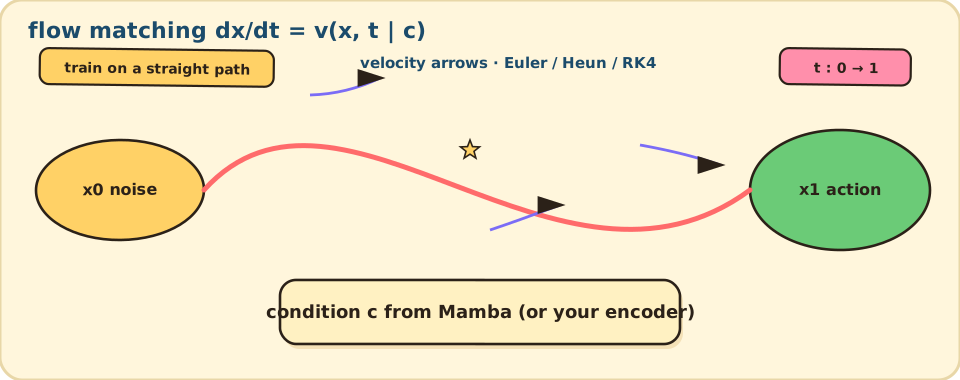
The contract
class MyHead {
  MyHead(std::span<const TensorView> weights, Arena& scratch) noexcept;
  bool valid() const noexcept;
  void sample(std::span<const float> cond,    // conditioning vector, size d_model
              std::span<const float> noise,   // action_dim
              std::size_t steps, Method m,
              std::span<float> out) noexcept;  // action chunk
};
The constructor resolves weight pointers by name and derives config from their shapes. sample reads the conditioning vector and writes the action. It allocates nothing.
Steps
Create
src/core/heads/<name>/<name>.{h,cc}. Resolve weight pointers in the constructor. Set anok_flag only when every required tensor is present.Add any missing kernel to
kernels.h. If it is public, implement it inkernels_avx2.cc,kernels_neon.cc, andkernels_scalar.cc, or the fallback build will not link.Carve scratch with
arena_span. Takemark()at the top ofsampleandreset_toat the end. Nothing allocates on the hot path.Add a converter mapping so a checkpoint loads. See Converter. Carry the normalization stats and un-normalize the action if the checkpoint stores them.
Add a sampling entrypoint to the C-ABI, or a head selector on
fe_engine_sample.Add a PyTorch reference to
tools/benchmark/torch_ref.pyand wire the ULP gate.Add tests to
test/core_model_tests.cc(ortest/kernel_tests.ccfor primitives). Add an example. Tick the head on the home page cards and write an ADR.
Reference: src/core/heads/flow/flow.h and flow.cc.