Converter
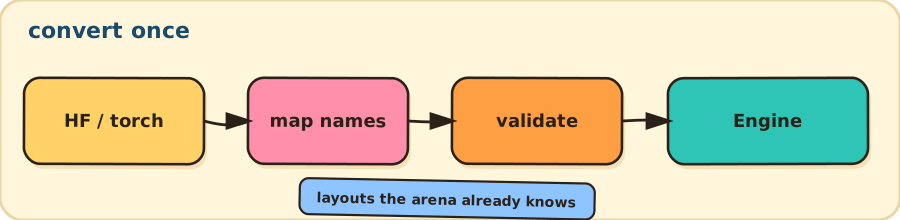
FlowEdge loads fixed tensor layouts: backbone.* for the backbone, flow.* for
the flow head, and dp.* for the Diffusion Policy head. The converter maps a
PyTorch or Hugging Face checkpoint into those layouts.
python -m flowedge_dev pipeline convert <source> models/out.safetensors --arch mamba
Convert a GPT-2-style decoder (model_type: gpt2) into the Transformer
fixture. sshleifer/tiny-gpt2 is the CI fixture; openai-community/gpt2 is optional:
hf download sshleifer/tiny-gpt2 --local-dir models/tiny-gpt2
python -m flowedge_dev pipeline convert models/tiny-gpt2 \
  models/tiny-gpt2.flowedge.safetensors --arch transformer
This maps learned positions, affine LayerNorm, GELU MLPs, and GPT-2 fused QKV attention. It does not convert the tokenizer, LM head, visual encoder, or the SmolVLA action expert.
Extract only the action head for an external encoder:
python -m flowedge_dev pipeline convert models/full.safetensors models/head.safetensors \
  --arch mamba --component head --dtype bf16
--component backbone drops the head; all preserves both. Head-only output validates the four
required flow projections and is directly loadable through fe_engine_sample_condition.
A mapping
An architecture is one function in the ARCH registry. It takes the source state dict and returns a dict keyed by FlowEdge names.
def mamba(sd):
    out = {}
    for k, v in sd.items():
        k = k.replace("backbone.embedding.weight", "backbone.embeddings.weight")
        if k.startswith("backbone.") or k.startswith("flow."):
            out[k] = v
    return out

ARCH = {"mamba": mamba}
FlowEdge uses PyTorch [out, in] linear layout, so most weights need no transpose. Rename keys, drop what the engine does not use, and transpose only where the source layout differs.
Validation and normalization
REQUIRED_BACKBONE and REQUIRED_FLOW list the tensors the model constructors look for. The
converter checks the selected component and stops if it is incomplete. Keep these lists in sync
with the constructors.
With --dtype bf16, only two-dimensional matmul weights are narrowed. Embeddings, normalization,
biases, convolution weights, A_log, and D remain F32 because the current kernels and model
constructors require them in that format.
If the source normalizes actions with dataset stats, carry those stats through and un-normalize the sampled action. Otherwise the output stays in normalized space.
LeRobot Diffusion Policy
Download lerobot/diffusion_pusht, then pass its directory so the converter can
read both model.safetensors and config.json:
hf download lerobot/diffusion_pusht --revision 84a7c23178445c6bbf7e1a884ff497017910f653 \
  --local-dir models/diffusion_pusht
python -m flowedge_dev pipeline convert models/diffusion_pusht \
  models/diffusion_pusht.flowedge.safetensors --arch diffusion
This maps ConditionalUnet1D, shortens tensor names for the fixed loader,
stores horizon/dimension/scheduler metadata, and preserves action min/max. It
drops the RGB encoder by design. Unsupported schedules, prediction modes,
normalization, or U-Net variants fail with a specific conversion error.
Source: convert/convert.py. See ADR 0006.