Diffusion Policy
A diffusion policy treats the action horizon as the thing being denoised. LeRobot trains a Conv1D U-Net that predicts noise given a noisy chunk, a timestep, and an observation condition. FlowEdge runs that U-Net in a fixed arena (DDIM by default, seeded DDPM for reference) and un-normalizes with the checkpoint MIN_MAX stats. The RGB encoder stays in LeRobot.
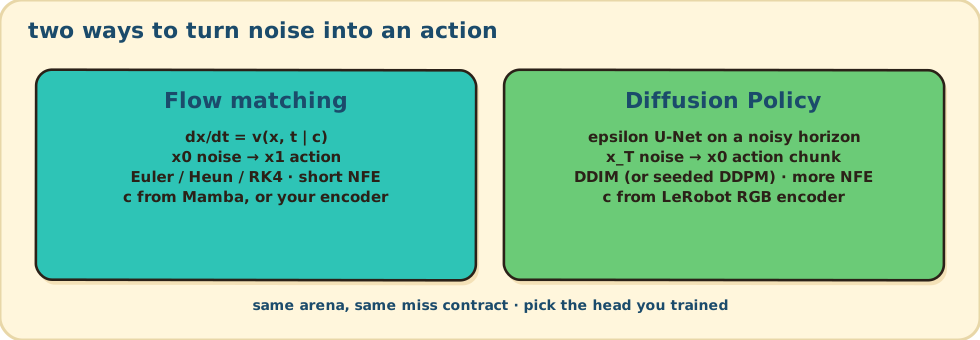
Fixed-memory diffusion_pusht contract below. For the matched PyTorch p50 and
the 10 ms miss count, see Performance.
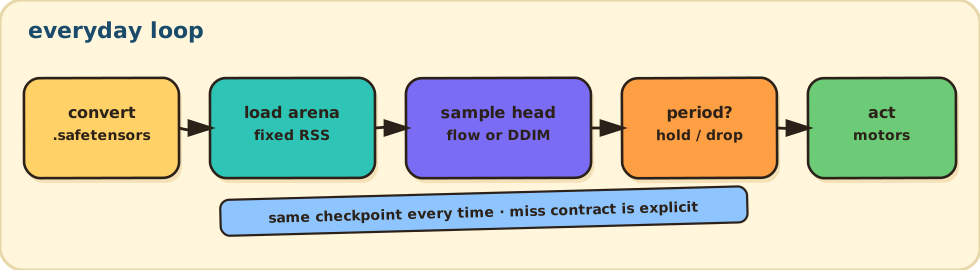
Contract: fixed horizon / action dim / U-Net widths; Conv1D + ConvTranspose1D; GroupNorm, Mish, sinusoidal timestep, FiLM; squaredcos_cap_v2 epsilon; DDIM / seeded DDPM; MIN_MAX un-normalize.
Reference: horizon 16, action dim 2, action steps 8, observation steps 2, widths 512/1024/2048, timestep 128, 100 train steps. Pinned revision 84a7c23178445c6bbf7e1a884ff497017910f653. Newer LeRobot migrations may put action stats in policy_postprocessor.json; the converter reads action.min / action.max from unnormalizer_processor. MIN_MAX only.
Observation boundary
FlowEdge does not run the reference ResNet18 image encoder. Run LeRobot’s
observation preprocessing and encoder externally, then pass the flattened
condition immediately before DiffusionConditionalUnet1d.
For diffusion_pusht, each of the two observation steps contributes the
normalized 2-value robot state followed by the 64-value spatial-softmax image
feature. Flatten the [2, 66] tensor in time order to obtain the 132-value
condition. The converter derives and validates this width from every FiLM
projection rather than hard-coding it.
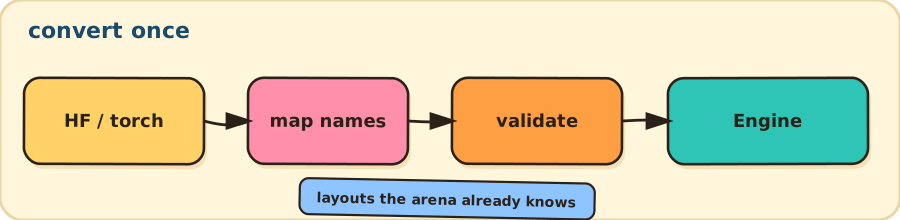
Convert and sample
hf download lerobot/diffusion_pusht --revision 84a7c23178445c6bbf7e1a884ff497017910f653 \
  --local-dir models/diffusion_pusht
python -m flowedge_dev pipeline convert models/diffusion_pusht \
  models/diffusion_pusht.flowedge.safetensors --arch diffusion
./build/diffusion_sample models/diffusion_pusht.flowedge.safetensors 10
FLOWEDGE_BACKEND=cuda keeps the U-Net and DDIM scratch on device after load.
Compare that diffusion_sample binary to a CPU build on the same checkpoint and
noise. Matched CUDA vs PyTorch CUDA policy p50 on GTX 1650 is 131 ms vs 345 ms
(Performance).
For a non-standard processor filename, pass it explicitly with
--processor path/to/policy_postprocessor.json. Observation preprocessing
remains outside FlowEdge; only action un-normalization statistics are imported
from the processor state.
The output contains the whole 16-step denoised horizon in original PushT action
units. LeRobot normally executes only n_action_steps, beginning at index
n_obs_steps - 1; keep that slicing policy in the controller.
Verify and benchmark
tools/verification/verify_diffusion.py (python -m flowedge_dev verify diffusion) creates a small LeRobot-shaped checkpoint, runs the
converter, loads the Python extension, and checks denoiser, DDIM, DDPM,
determinism, metadata, and un-normalization against an independent PyTorch
reference. Current explicit tolerances are 2e-4 for one denoiser pass, 4e-4
for DDIM, and 8e-4 for seeded DDPM; observed errors are printed.
PYTHONPATH=build python -m flowedge_dev verify diffusion build
PYTHONPATH=build python -m flowedge_dev verify diffusion-public \
  models/diffusion_pusht/model.safetensors \
  models/diffusion_pusht.flowedge.safetensors --build build
The former C++ latency runner generated its own condition and noise, so it was removed. Use the matched visual-policy replay in the performance guide for end-to-end measurements with captured observations and source preprocessing.
Limits
Batch size is one. Shapes are fixed at conversion. Convolution and normalization weights remain F32; two-dimensional linear weights may be BF16. The scalar diffusion kernels use fixed-shape loop specializations and the existing CPU thread pool; ISA-specialized convolution is still planned. Training, image encoding, arbitrary schedulers, dynamic horizons, and accelerator backends are outside this initial path.