Memory Arena
One fixed buffer and a bump pointer.
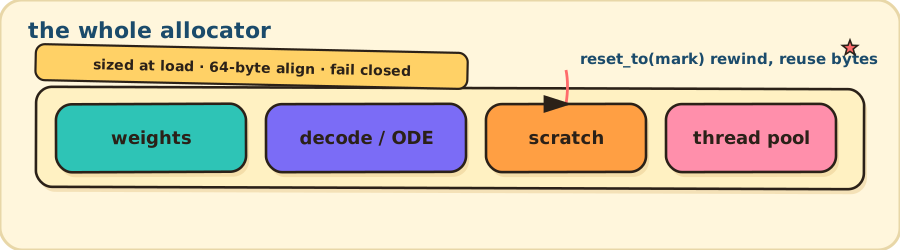
At load the engine sizes the slab from the checkpoint, then carves weights
once, 64-byte aligned. Decode state, resumable-flow workspace, SSM matrices,
the task ring, and worker std::jthread objects live in the same slab.
How it works
The arena owns one std::byte slab and a cursor. alloc(n, a) uses
std::align, hands back the aligned span, and advances by n. Every allocation
is O(1) and contiguous, with no free list and no per-object header.
Scratch is stack-like: mark() records the cursor and reset_to() winds it back. A layer carves its intermediates, and the caller rewinds to the mark afterward, so the next layer reuses the same bytes.
The slab size is fixed at load:
\(W_{bytes}\) is the stored weight footprint in bytes (2 bytes per element for
BF16 weights). \(S_{decode}\) covers Mamba conv windows, SSM state, and the
state-major \(-\exp(A_{\log})\) matrix per layer. \(S_{flow}\) covers the resumable
ODE state, velocity temporaries, and projection scratch. \(R_{pool}\)
covers the power-of-two task ring and worker objects. alloc returns nullptr
on exhaustion, so a model that does not fit fails at load instead of drifting
into the control loop.
Why this way
malloc walks lists, takes locks, and faults pages. A bump + reset_to(mark) does none of that; the slab is touched once at load. 64-byte alignment matches the cache line and SIMD. One scratch region is reused every layer. Footprint is \(O(1)\) in the horizon, not a growing KV cache.
Engines may share immutable ModelWeights. Inference uses raw views.
Source: src/core/arena/arena.h.